One of the easiest mistakes people make when moving to Boise is assuming every commute will be short because the Treasure Valley looks compact on a map.
Sometimes it is.
Sometimes it absolutely is not.
Boise itself is relatively easy to navigate compared with a much larger metro, but the Treasure Valley has grown quickly, and traffic is concentrated along a limited number of major east-west and north-south corridors.
That means where you live can have a significant effect on how much time you spend driving every week.
This guide explains the Boise-area commute in 2026, including I-84, Eagle Road, Meridian Road, Chinden Boulevard, State Street, Downtown Boise, Meridian, and what relocating households should test before signing a lease or buying a home.
Boise Traffic at a Glance
The good news is that Boise is not Los Angeles, Seattle, Dallas, or Phoenix.
Most commutes are still relatively manageable by big-city standards.
But that does not mean traffic should be ignored.
The biggest issues usually come from:
eastbound morning traffic toward Boise
westbound afternoon traffic toward Meridian and Canyon County
I-84 interchange congestion
Eagle Road
Meridian Road
Chinden Boulevard
State Street
school-zone traffic
road construction
major crashes on I-84
The commute can change dramatically depending on where you live and where you work.
Boise's Average Commute Is Only Part of the Story
Boise residents generally have shorter commute times than people in many larger metropolitan areas.
But citywide averages are not very useful if you personally live in west Meridian and work in Downtown Boise.
That household may spend far more time commuting than someone who lives on the Boise Bench and works downtown.
This is why your own route matters much more than a regional average.
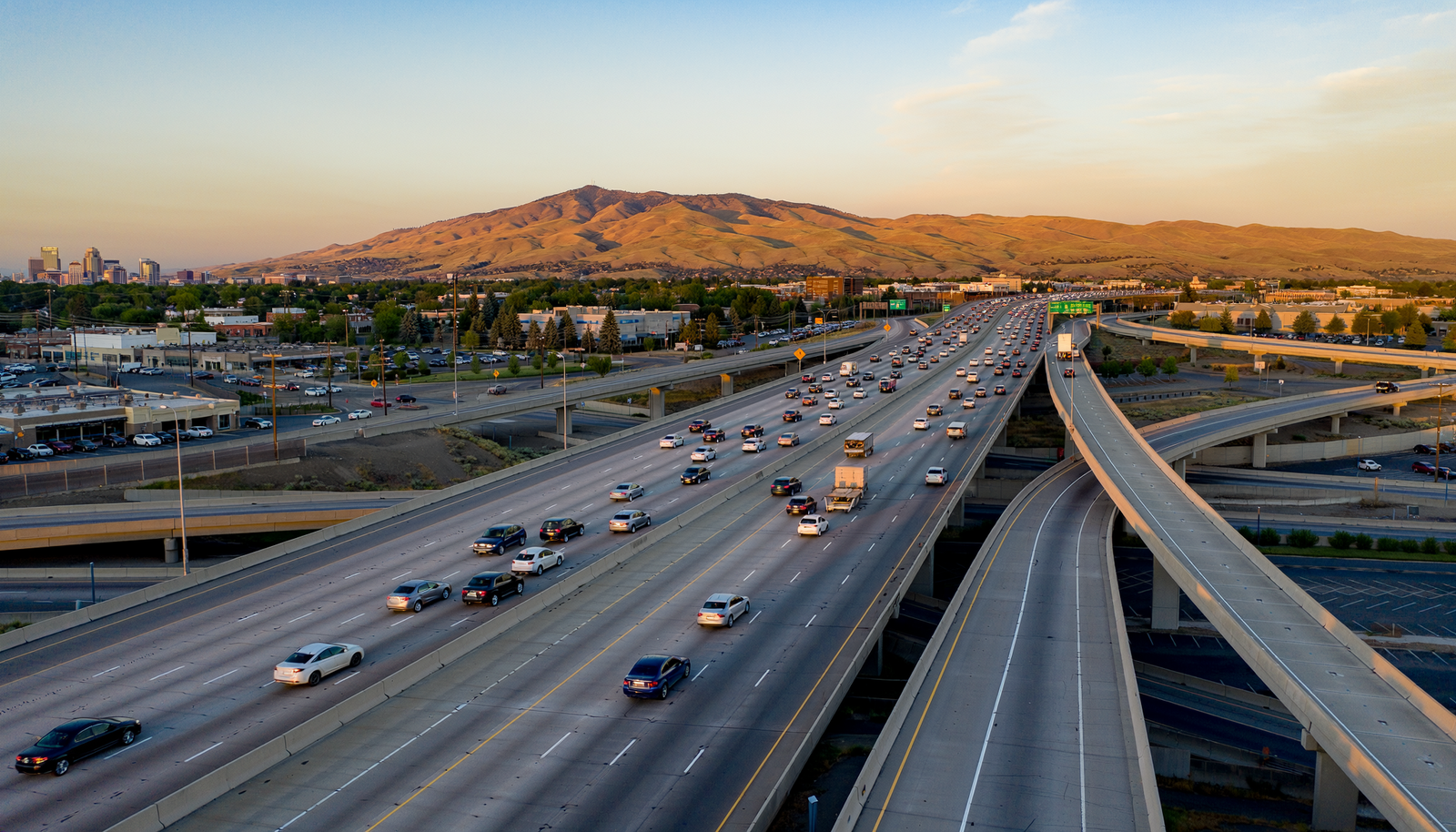
I-84 Is the Treasure Valley's Main Commuter Artery
Interstate 84 is the most important transportation corridor in the Boise metro.
It connects Boise, Meridian, Nampa, Caldwell, Boise Airport, major employment areas, and shopping and commercial districts.
That also means it carries a huge share of regional commuter traffic.
The Idaho Transportation Department says traffic volumes on portions of I-84 increased by almost 15% between 2019 and 2025.
ITD is studying additional lanes, auxiliary lanes, interchange improvements, ramp metering, incident detection, and other traffic-management strategies to handle continued growth.
I-84 Is Still Getting Busier
ITD projects major long-term traffic growth between Nampa and Boise.
Its current mobility study estimates that by 2055, Garrity Boulevard to Ten Mile could grow by 47%, Ten Mile to Meridian Road by 44%, Meridian Road to Eagle Road by 38%, and Eagle Road to the Flying Wye by 31%.
Those are long-range projections, but they help explain why transportation planning has become such a major Treasure Valley issue.
For someone moving here today, the practical takeaway is simple: do not assume today's commute will remain unchanged forever.
Morning Traffic Generally Moves Toward Boise
A major weekday traffic pattern is eastbound movement toward Boise in the morning.
That includes commuters coming from Meridian, Nampa, Caldwell, Kuna, and western Ada County.
If you live west of Boise and work in Boise, expect your morning commute to overlap with a large regional flow of traffic.
The reverse pattern often becomes more noticeable in the afternoon.
Meridian Road to Eagle Road Is an Important Bottleneck
The Meridian Road and Eagle Road portion of I-84 is especially important.
ITD specifically notes significant peak-hour congestion at interstate ramps and nearby streets, which can create backups both on I-84 and on the surface-road network.
That matters because both Meridian Road and Eagle Road are major north-south routes serving some of the fastest-growing parts of the metro.
Eagle Road
Eagle Road is one of the Treasure Valley's busiest commercial corridors.
It connects I-84 with The Village at Meridian, major shopping centers, restaurants, medical offices, subdivisions, and Eagle farther north.
It is extremely convenient.
It can also be frustrating.
Traffic lights, retail entrances, turning traffic, and high demand can slow the corridor considerably during peak periods.
If you are considering a house because it is close to Eagle Road, understand that proximity does not necessarily mean a fast commute.
Meridian Road
Meridian Road is another major north-south route.
It connects central Meridian with I-84 and surrounding residential areas.
During commute periods, the interchange can become congested as drivers funnel onto the freeway.
This is particularly relevant if you live north or south of I-84 and need to enter the interstate every morning.
Ten Mile Road
Ten Mile has become increasingly important as west Meridian develops.
The area around the interstate has attracted substantial commercial, residential, and employment growth.
For someone working near Ten Mile, living in Meridian may allow you to avoid driving farther east toward Boise entirely.
That can have a major effect on quality of life.
The Flying Wye
The Flying Wye is where I-84 and I-184 connect on the western side of Boise.
It is one of the most important freeway junctions in the metro.
Drivers heading toward Downtown Boise often transition onto I-184 here.
Drivers continuing toward the airport or Southeast Boise remain on I-84.
Because so many routes converge here, crashes or heavy traffic can have effects well beyond the immediate interchange.
I-184 Into Downtown Boise
I-184, commonly called the Connector, provides direct freeway access into Downtown Boise.
For residents of West Boise and parts of Meridian, it can make downtown access relatively simple when traffic is moving normally.
The biggest variable is usually getting to I-184 in the first place.
Once you reach the Connector, Downtown Boise is relatively close.
Commuting From Meridian to Downtown Boise
This is one of the most common relocation scenarios.
The distance may look modest.
The experience depends heavily on your exact Meridian neighborhood, which I-84 interchange you use, time of departure, crashes, school traffic, and downtown parking.
If you are considering this commute, test it yourself during an actual weekday rush period.
Do not rely only on a navigation app's estimate from Sunday afternoon.
Our Boise vs. Meridian: Where Should You Live in 2026? goes deeper into the lifestyle tradeoffs.
Commuting From West Boise to Downtown
West Boise can be a useful compromise.
You remain within Boise while staying closer to Meridian and the western Treasure Valley.
Depending on the neighborhood, you may have access to I-184, Fairview Avenue, Ustick Road, Chinden Boulevard, and Franklin Road.
That can make West Boise attractive for households with one person working downtown and another working farther west.
Read our Ultimate Guide to West Boise.
Boise Bench to Downtown
The Boise Bench is one of the more centrally located residential areas.
For many residents, getting downtown does not require using I-84 at all.
Major routes include Vista Avenue, Capitol Boulevard, Americana Boulevard, and Orchard Street.
The Bench also provides convenient access to Boise Airport.
That central location is one reason the area can work well for people trying to minimize overall driving.
Read our Ultimate Guide to the Boise Bench.
Southeast Boise to Downtown
Southeast Boise generally offers straightforward access to Downtown Boise.
Depending on location, commuters may use Parkcenter Boulevard, Boise Avenue, Broadway Avenue, Myrtle Street, and Front Street.
The area also provides strong access to Boise State University and the Boise River corridor.
Read our Ultimate Guide to Southeast Boise.
North End to Downtown
The North End is one of the easiest areas for people working Downtown Boise.
Many residents have relatively short drives.
Some can walk or bike depending on where they live and work.
The tradeoff is that housing in the North End can be more expensive than in farther-out suburban areas.
Read our Ultimate Guide to Boise's North End.
East End to Downtown
The East End also provides very strong access to Downtown Boise.
Warm Springs Avenue and nearby streets make the trip relatively direct.
For someone working downtown and wanting foothills access, the East End can be particularly appealing.
Read our Ultimate Guide to Boise's East End.
Chinden Boulevard
Chinden Boulevard, also known as U.S. 20/26, is another major east-west corridor.
It connects areas of Boise, Garden City, Meridian, Eagle, Star, and points farther west.
For some households, Chinden is an alternative to I-84.
That does not necessarily mean it is faster.
Chinden Is Changing
Growth along the Chinden corridor continues to drive road and intersection projects.
ACHD completed an enhanced crossing project at Chinden Boulevard and 43rd Street in 2026, including raised medians and a pedestrian signal.
Farther west, road-capacity planning continues as Star and surrounding communities grow.
State Street
State Street is another major route connecting Boise with Eagle and areas northwest of the city.
It can be useful for commuters who live north of the Boise River and want to avoid I-84.
But it is also a major commercial corridor with traffic lights, retail access, turning traffic, and school traffic.
If your daily route uses State Street, test it during rush hour before deciding how convenient a neighborhood really is.
Eagle to Boise Commute
Eagle is relatively close to Boise, but the commute depends heavily on exact location.
Common routes include State Street, Eagle Road, and Chinden Boulevard.
Recent ACHD improvements around Eagle Road and State Street were designed to improve mobility and safety as the area continues growing.
Again, Eagle to Boise is not one commute.
A home in south Eagle near Chinden creates a different daily routine than a property farther north.
Star to Boise Commute
Star sits farther west and northwest.
The community continues growing, and transportation agencies are planning for increased traffic.
ACHD is developing plans to widen Star Road between Chinden Boulevard and State Street to five lanes, add multi-use paths, and replace the Boise River bridge.
Construction is currently expected in phases beginning in 2029.
For someone moving to Star but working in Boise, the commute should be a major part of the housing decision.
Nampa to Boise Commute
Nampa offers a different housing market than Boise and Meridian.
But it also places you farther west.
Someone working in Boise may save money on housing while spending significantly more time driving.
That tradeoff can still make sense.
But calculate fuel, vehicle wear, commute time, I-84 exposure, and childcare pickup schedules.
A lower mortgage is not automatically a better deal if the household spends ten additional hours a week driving.
Caldwell to Boise Commute
Caldwell is farther west again.
For people working remotely or working in Canyon County, that may be fine.
For a daily Boise commuter, it deserves serious consideration.
I-84 gives you a direct route.
It also means you depend heavily on the interstate.
What Happens When I-84 Has a Crash?
This is where the Treasure Valley transportation network can become frustrating.
Because I-84 carries so much regional traffic, a serious crash can quickly affect freeway speeds, interchange ramps, parallel arterial roads, Eagle Road, Franklin Road, Fairview Avenue, and Chinden Boulevard.
Navigation apps can help reroute you, but thousands of other drivers may receive the same suggestion.
Build some flexibility into your schedule if your commute depends on I-84.
Construction Is Part of the Commute
Treasure Valley growth means roadway construction is common.
Projects may involve widening, intersection changes, bridge replacements, signal work, pedestrian improvements, new turn lanes, and utility work.
Some improvements eventually make travel easier.
During construction, they can temporarily make it worse.
Before buying in a fast-growing area, check planned transportation projects nearby.
Road Projects Can Also Change Neighborhoods
Road improvements are not only about commute times.
A future widening project can affect traffic noise, driveway access, bike infrastructure, pedestrian access, and property frontage.
ACHD's Star Road project, for example, includes planned right-of-way acquisition along with widening and new multi-use pathways.
That is why buyers near major corridors should research future projects before closing.
School Traffic Matters
Your work commute is not the only traffic pattern.
School drop-off and pickup can significantly affect neighborhood roads.
This matters particularly if you live near an elementary school, your route crosses a school zone, or your children attend school across town.
Our Boise Schools Guide for Families Moving to Idaho explains why school location should be considered alongside the work commute.
Working at Micron
Micron's Boise campus is in southeast Boise.
Someone working there should look carefully at Southeast Boise, East Boise, Boise Bench, and parts of Meridian with good I-84 access.
A home far west may still work, but you will be crossing a large portion of the metro.
Housing should be evaluated against the daily drive.
Working at Boise State University
Boise State is close to Downtown Boise and Southeast Boise.
Nearby neighborhoods can dramatically reduce driving.
The Boise River Greenbelt may also provide biking access from some parts of the city.
That can turn a conventional car commute into something much easier.
Working at Boise Airport
Boise Airport sits south of the city near I-84.
Convenient areas include Boise Bench, Southeast Boise, South Boise, and parts of West Boise.
The airport's central location relative to the metro is one of Boise's advantages.
Read our Boise Airport Guide.
Working in Downtown Boise
If your office is downtown, living centrally can have substantial value.
Areas to consider include Downtown, North End, East End, Boise Bench, and Southeast Boise.
You may pay more for housing in some of these neighborhoods.
But you may also spend much less time and money commuting.
Working Near Eagle Road
If your employer is around Eagle Road or The Village, Meridian or West Boise may make more sense than central Boise.
A common relocation mistake is choosing the neighborhood people say is best instead of choosing the neighborhood closest to your real daily activity.
Working Near Ten Mile
For someone working near Ten Mile Road, west Meridian can be extremely convenient.
Living in central Boise and commuting west every day may add unnecessary driving unless you strongly prefer Boise's lifestyle.
Remote Workers Still Need to Think About Location
Remote workers do not have a conventional commute.
But they still drive to school, childcare, groceries, restaurants, medical appointments, recreation, and children's activities.
Someone who works from home may actually make more short trips throughout the week.
Do not ignore transportation simply because your office is upstairs.
Can You Live in Boise Without a Car?
In some neighborhoods, you can dramatically reduce car use.
That is easiest in Downtown, North End, East End, areas near Boise State, and parts of Boise Bench.
But the broader Treasure Valley remains car-oriented.
Most families will still want at least one vehicle.
The Boise River Greenbelt as Transportation
The Greenbelt is primarily recreational, but for some residents it can also provide useful bike access.
It connects Downtown Boise, Boise State, Southeast Boise, Garden City, and major parks.
For someone who lives and works near the river corridor, biking may be realistic for at least part of the year.
Read our Boise Greenbelt Guide.
Bike Commuting
Boise's climate allows bike commuting during much of the year.
But conditions vary.
Summer heat can make afternoon riding uncomfortable.
Winter snow and ice can complicate travel.
Smoke may affect air quality during wildfire season.
The most practical bike commute is one where the route itself is safe and convenient, not merely short.
Public Transportation
Valley Regional Transit operates bus service throughout parts of the Treasure Valley.
Public transit can work for some commuters.
But Boise does not currently have the kind of extensive rail system available in many larger metropolitan areas.
For most households, transit should be researched based on the exact home-to-work route rather than assumed as a complete replacement for a car.
Downtown Parking
Working downtown introduces another variable: parking.
A short drive can still become expensive or inconvenient if your employer does not provide parking.
Downtown Boise has public garages and metered street parking.
Read our Downtown Boise Parking Guide before evaluating a downtown commute.
Winter Commuting
Boise winters are generally milder than Idaho mountain communities.
But you may still encounter snow, ice, freezing fog, slick bridges, and shaded icy streets.
Your normal 20-minute drive may take longer during winter weather.
Allow more time and avoid assuming road conditions are identical throughout the valley.
Summer Construction Season
Summer often brings more road construction.
That can overlap with higher recreation traffic, tourism, airport travel, and events.
Check construction maps before deciding that your normal route is always the fastest one.
Boise State Game Days
Boise State football can affect traffic around Broadway Avenue, Myrtle Street, Parkcenter, Downtown, and Southeast Boise.
If you live or work near campus, understand the home-game schedule.
One Saturday may look very different from the next.
Downtown Events
Large festivals and events can also affect road closures, parking, surface traffic, and garage availability.
Treefort, major concerts, races, and other events can temporarily change normal routes.
Commute Time vs. Housing Cost
This is where relocation decisions become personal.
Imagine two homes.
House A
Costs more but is 10 minutes from work.
House B
Costs less but creates a 40-minute commute each way.
The cheaper house may still be the right choice.
But calculate what it actually means.
An extra hour of commuting per workday is roughly five additional hours per week.
Over a year, that can become hundreds of hours.
Time has value too.
Calculate Fuel
Longer commutes also create direct financial costs.
Estimate weekly mileage, fuel, maintenance, tires, oil, and depreciation.
That should be part of your housing decision.
Our Cost of Living in Boise, Idaho in 2026 explains why housing and transportation should be considered together.
Commute and Childcare
Parents have another constraint.
If daycare closes at 6 p.m., an unpredictable commute matters.
A house farther away may create pickup stress, late fees, scheduling problems, and less flexibility.
Families should test the entire routine, not just the route from home to the office.
Commute and School Activities
The same applies to sports and extracurricular activities.
If work is in Boise, home is in Meridian, and soccer practice is somewhere else entirely, the family's weekly driving can add up quickly.
Look at the complete household map.
Best Strategy Before Buying
Take the address of a house you are considering.
Drive from that house to work, school, grocery store, daycare, airport if you travel frequently, and activities you use regularly.
Do it during realistic times.
That is far more valuable than looking only at mileage.
Use Navigation Apps, But Do Not Trust One Snapshot
Google Maps, Apple Maps, and other tools are useful.
Use historical or departure-time estimates when available.
But a single route check does not tell the whole story.
Test Monday morning, weekday afternoon, school pickup time, and Friday evening.
Patterns change.
A Practical Boise Commute Checklist
Before choosing a home, ask:
Where will each adult work?
Which I-84 interchange will we use?
Do we depend on Eagle Road?
Do we depend on Meridian Road?
Is there a realistic alternate route?
How far is school?
How far is childcare?
How much downtown parking costs?
Could biking work?
What happens if I-84 is blocked?
If those answers look bad, the house may not be the bargain it appears to be.
Areas That Minimize Downtown Commutes
If Downtown Boise is your primary destination, consider starting with Downtown, North End, East End, Boise Bench, and Southeast Boise.
These areas generally reduce reliance on long I-84 trips.
Areas That Work Well for Meridian Employment
If most of your life is centered in Meridian, consider Meridian, West Boise, areas near Ten Mile, areas near Eagle Road, and northern Meridian depending on workplace.
The goal is to avoid unnecessary cross-valley driving.
There Is No Single Best Commute
This is the most important point.
Boise traffic is not uniformly bad.
It is route-specific.
Someone may have an easy 12-minute commute while another person living only a few miles farther away deals with a major interchange every morning.
Where you work matters.
Where you live matters.
Which road sits between the two matters.
The Bottom Line
Boise remains easier to commute around than many major U.S. metros, but Treasure Valley growth has made transportation a serious relocation consideration.
I-84 traffic volumes have grown significantly, and transportation agencies are already studying and planning substantial improvements to accommodate future demand.
Eagle Road, Meridian Road, Chinden Boulevard, State Street, and other major corridors can also become congested during peak periods.
The smartest approach is not to ask whether Boise traffic is bad.
Ask whether your specific commute is bad.
Take the exact address.
Drive the route during rush hour.
Check school and childcare travel.
Look at planned road projects.
Then decide whether the home still makes sense.
A slightly smaller house closer to your daily life may give you more usable time every week than a larger house that puts you on I-84 twice a day.
This post may contain affiliate links. We may earn a commission when you purchase through links on this site at no additional cost to you.