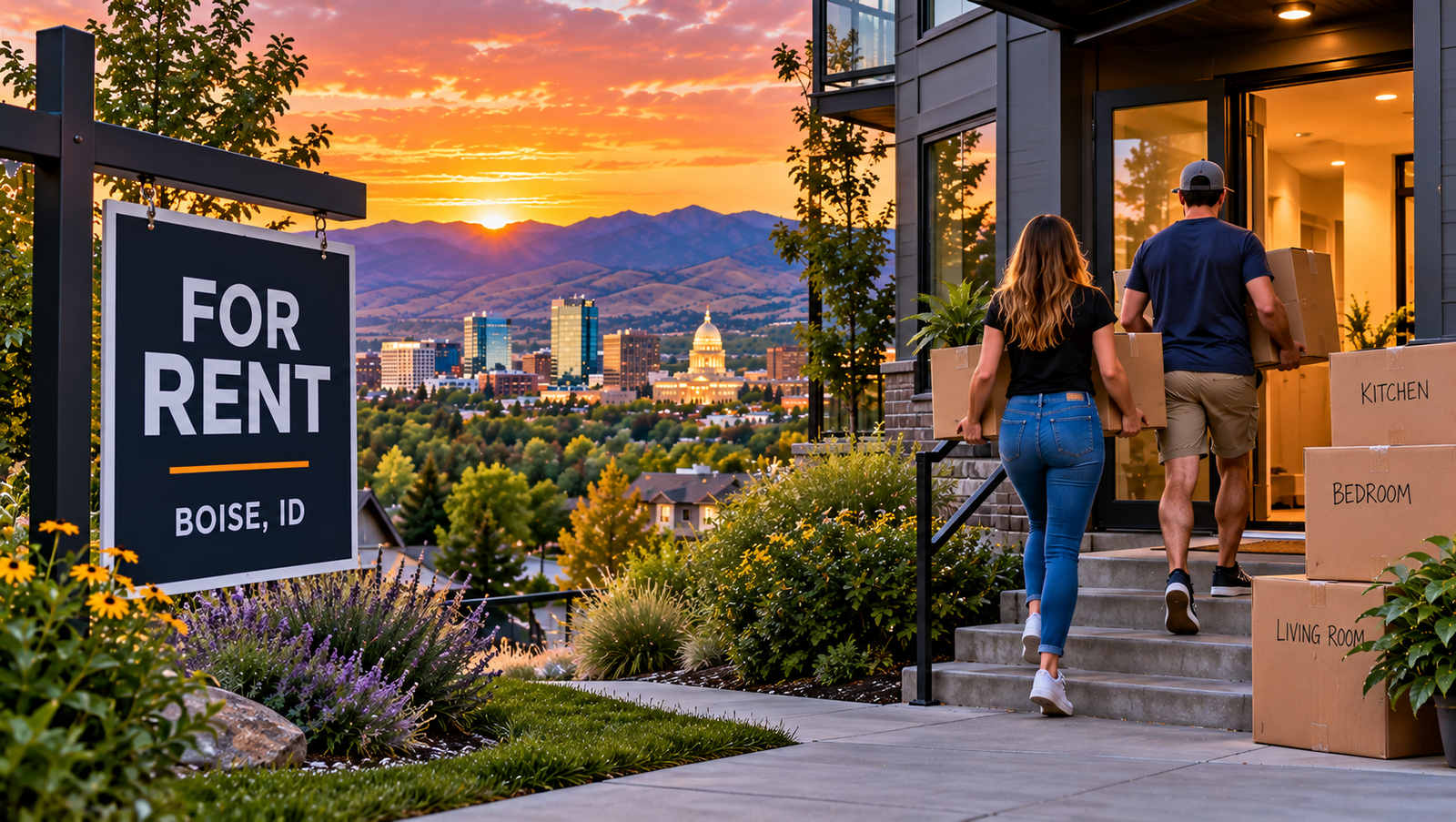
Renting can be one of the smartest ways to move to Boise.
Not because Boise rent is especially cheap.
It is not.
Renting gives you time to learn the city before making a much larger housing decision.
You can figure out whether you actually prefer Downtown Boise, the North End, Southeast Boise, the Bench, West Boise, Meridian, or somewhere else in the Treasure Valley.
You can test your commute.
You can learn school boundaries.
You can experience summer heat, winter weather, traffic, and neighborhood routines before committing to a mortgage.
For many newcomers, that flexibility is worth a year of renting.
This guide covers Boise rents in 2026, where to look, what to budget beyond monthly rent, security deposits, leases, pets, utilities, rental scams, and what to inspect before signing.
Boise Rent at a Glance
As of September 2026, Zillow reports an average asking rent across all bedrooms and property types in Boise of about $1,995 per month.
That is roughly $150 higher than a year earlier.
Current averages include approximately:
1-bedroom: $1,542 per month
2-bedroom: $1,795 per month
Those are citywide averages.
Actual rent can vary considerably depending on neighborhood, apartment versus house, number of bedrooms, garage, yard, age of property, amenities, pet policy, lease term, proximity to Downtown, and Greenbelt access.
Do not build your budget around one citywide number.
Boise Is Not Automatically a Cheap Rental Market
One of the biggest mistakes newcomers make is assuming Idaho means low rent.
That may have been closer to reality years ago.
It is much less reliable in 2026.
Boise housing costs rose dramatically during the past decade, and rental pricing reflects that.
Someone moving from San Francisco, Seattle, or Los Angeles may still consider Boise relatively affordable.
Someone moving from a lower-cost Midwestern or Southern city may feel the opposite.
Our Cost of Living in Boise, Idaho in 2026 breaks down the broader household budget.
Why Renting First Can Make Sense
Renting gives you something extremely valuable when relocating: information.
A year in Boise can teach you things an online search cannot.
you hate your commute
you love being near the Greenbelt
you rarely go downtown
Meridian fits your routine better
you want foothills access
your child's school situation changes your preferred area
you want an older neighborhood instead of new construction
That information can prevent a much more expensive home-buying mistake later.
Apartment or Rental House?
Boise offers both.
Apartments may offer lower upfront maintenance responsibility, amenities, pools, fitness centers, package rooms, easier short-term flexibility, and professional property management.
Rental houses may offer more bedrooms, a garage, a yard, more privacy, neighborhood feel, storage, and space for pets.
Rental houses can also come with additional responsibilities such as landscaping, irrigation, snow removal, or utility accounts.
Read the lease carefully.
Downtown Boise Rentals
Downtown is a good fit for renters who want walkability, restaurants, nightlife, events, easy access to Boise State, Greenbelt proximity, and less driving.
You will find apartments, condos, and newer mixed-use developments.
The tradeoff is that rent may be higher than in some farther-out areas.
Parking can also become a separate monthly cost.
Read our Ultimate Guide to Downtown Boise.
North End Rentals
The North End offers mature trees, historic homes, Hyde Park, foothills access, and proximity to Downtown.
Rental inventory can include apartments, duplexes, accessory units, and older houses.
Homes here may have more character but fewer modern apartment-style amenities.
Read our Ultimate Guide to Boise's North End.
Southeast Boise Rentals
Southeast Boise is attractive for Boise State access, Greenbelt, Boise River, Parkcenter, Bown Crossing, and parks.
It can be a strong choice for people working at Boise State, Micron, Downtown Boise, or other southeast employment areas.
Read our Ultimate Guide to Southeast Boise.
Boise Bench Rentals
The Bench can offer a useful balance of central location, airport access, older neighborhoods, apartments, duplexes, and single-family rentals.
For commuters who want to avoid a long I-84 drive, the Bench deserves consideration.
Read our Ultimate Guide to the Boise Bench.
West Boise Rentals
West Boise is more suburban and puts you closer to Meridian.
That can make sense for renters whose work or daily activities are west of Downtown Boise.
Housing options include apartments, townhomes, duplexes, and houses.
Read our Ultimate Guide to West Boise.
What About Meridian?
Do not stop your search at Boise city limits.
Meridian can make more sense if you work near Eagle Road, work near Ten Mile, want newer apartments, want suburban amenities, have children in West Ada, or spend more time west of Boise.
But Meridian should not automatically be treated as cheaper.
Rent and housing costs can be similar.
Use our Boise vs. Meridian: Where Should You Live in 2026? before deciding.
Look at Commute Before Rent
Suppose one apartment costs $150 less per month.
That sounds good.
But what if it adds 40 minutes of driving every day?
Now add fuel, vehicle wear, time, childcare pickup pressure, and stress.
The cheaper apartment may no longer be the better deal.
Use our Boise Commute Guide before signing a lease.
How Much Should You Budget Up Front?
Monthly rent is only one part of move-in cost.
Depending on the property, you may need money for first month's rent, security deposit, application fees, pet deposit, pet rent, utility deposits, renters insurance, moving costs, and internet installation.
Someone renting a $1,800 apartment may need several thousand dollars available before move-in.
Ask for the complete move-in total before applying.
Security Deposits in Idaho
Idaho law treats money held by the landlord beyond rent as a security deposit.
At the end of the tenancy, the landlord generally must either return the deposit or provide the remaining deposit plus an itemized written explanation of deductions.
The standard deadline is 21 days after the tenancy ends.
A lease can extend that period to as much as 30 days, but not beyond that.
Landlords cannot deduct from the security deposit for normal wear and tear.
Document the Property at Move-In
This may be one of the most valuable things you do as a renter.
Before moving furniture in, photograph or video walls, floors, carpet, appliances, counters, cabinets, windows, doors, bathrooms, garage, yard, and existing damage.
Save the files somewhere secure.
If the property manager provides a move-in inspection form, complete it carefully.
Do not write everything looks good if it does not.
What Counts as Normal Wear and Tear?
Normal wear and tear generally means deterioration that occurs through ordinary use rather than tenant damage.
Examples may include ordinary carpet wear, minor wall scuffs, and aging paint.
Damage may include holes, broken fixtures, pet damage, unusual stains, and negligent damage.
The exact situation matters.
Documenting the condition at move-in makes disputes much easier to handle later.
Read the Entire Lease
Do not skim it.
The lease controls many of the practical details of your tenancy.
Look for lease length, rent due date, late fees, utility responsibility, pet rules, parking, guest rules, lawn maintenance, irrigation, snow removal, renewal, notice requirements, early termination, subleasing, and security deposit terms.
If something matters to you, make sure it is written into the agreement.
Ask What Happens at Renewal
Do not wait until month eleven.
Before signing, ask whether the lease automatically converts month-to-month, whether renewal is offered automatically, how much notice is required, whether there are month-to-month premiums, and how rent increases are communicated.
You may not know the future rent amount, but you should understand the process.
Utilities Can Change the Real Rent
A $1,700 apartment where several utilities are included may cost less overall than a $1,650 unit where you pay everything separately.
Ask specifically who pays electricity, gas, water, sewer, trash, recycling, and internet.
Do not accept some utilities included as enough information.
Ask which ones.
Electricity
Idaho Power serves much of the Boise area.
Electric costs vary with unit size, insulation, HVAC efficiency, thermostat settings, and season.
Summer air conditioning can increase usage substantially.
Natural Gas
Some rentals use natural gas for heat, water heating, or cooking.
That usually means a separate Intermountain Gas account.
Winter gas costs can vary considerably from summer.
Water, Sewer, and Trash
The setup depends on the property.
In some apartment complexes, these may be included in rent, billed at a flat rate, allocated among residents, or separately metered.
In rental houses, tenants may be responsible for setting up some services themselves.
Ask before signing.
Internet
Remote workers should verify internet at the exact address.
Do not assume a property has fiber because the neighborhood does.
Ask which providers serve the unit, what speeds are available, whether installation is needed, whether there is an exclusive provider agreement, and whether equipment is included.
If your income depends on reliable internet, this is not a minor detail.
Renters Insurance
Many landlords require renters insurance.
Even when they do not, it is usually worth considering.
The landlord's property insurance generally protects the building.
It does not automatically protect your personal belongings.
A renters policy may also include liability coverage.
Verify the requirements before move-in.
Pet Deposits and Pet Rent
Pet-friendly does not mean pets are free.
A property may charge a pet deposit, nonrefundable pet fee, or monthly pet rent.
There may also be breed restrictions, weight limits, or number-of-pet limits.
Ask about the complete pet cost before applying.
Two pets can materially change monthly rent.
Emotional Support and Assistance Animals
Assistance-animal rules are not the same as ordinary pet policies.
Fair housing laws may create rights to reasonable accommodations for qualifying individuals with disabilities.
If that applies to your household, use official fair housing or legal resources rather than relying on advice from social media.
Parking
Parking varies considerably.
Ask whether the rental includes assigned parking, covered parking, garage, guest parking, street parking, or EV charging.
Downtown renters should pay particular attention because garage parking may cost extra.
Storage
If you are moving from a larger home, storage can become an unexpected problem.
Check closets, garage, patio storage, bicycle storage, and outdoor equipment rules.
Boise residents often own gear for bikes, skiing, camping, paddleboards, and outdoor recreation.
An apartment can feel much smaller once the gear arrives.
Air Conditioning Matters
Boise summers get hot.
Verify that the rental has functional cooling.
Do not assume every older home has central air.
Some properties may use central AC, heat pump, mini-splits, window units, or evaporative cooling.
Ask what system is installed and whether the tenant is responsible for any maintenance.
Heating Matters Too
Winter temperatures regularly drop below freezing.
Ask how the property is heated.
Common systems include natural gas furnace, heat pump, and electric heat.
Heating type can affect winter utility costs.
Irrigation and Landscaping
If you rent a house, ask who handles the yard.
Responsibilities may include mowing, watering, irrigation, weeds, leaf cleanup, and sprinkler issues.
Treasure Valley irrigation systems may be unfamiliar to someone moving from another state.
Do not assume the property manager handles it.
Snow Removal
Boise does not get mountain-town snowfall, but snow and ice still happen.
A rental agreement may make the tenant responsible for driveway, sidewalk, or walkway.
Know your responsibility before the first storm.
School Boundaries for Renters
Renters need to verify school boundaries just as carefully as buyers.
A one-year lease inside a preferred school boundary can be a useful way to test the school, neighborhood, and commute before buying.
But verify the exact address directly with the school district.
Read our Boise Schools Guide for Families Moving to Idaho.
Renting With Children
Families should think about more than bedrooms.
Check school route, playgrounds, traffic, sidewalks, parks, childcare, grocery access, storage, and laundry.
A larger apartment does not automatically make a better family rental if the daily logistics are poor.
Laundry
Ask whether laundry is inside the unit, shared, coin-operated, app-operated, or hookups only.
If the property only has hookups, you may need to provide your own washer and dryer.
That affects move-in cost.
Rental Application Requirements
Application requirements vary by property manager.
You may be asked for identification, income verification, employment information, rental history, credit authorization, background check, and an application fee.
Ask for the written screening criteria before spending money on multiple applications.
Verify Income Requirements
Many landlords or property managers use an income multiple such as a certain amount of gross monthly income relative to rent.
The exact requirement varies.
Do not assume you qualify because you can personally afford the payment.
Ask for the property's published qualification criteria.
Moving From Out of State
Out-of-state renters face an additional challenge.
You may need to secure housing before you arrive.
That increases rental-scam risk.
In July 2026, the Idaho Attorney General warned renters about fake listings in high-growth markets.
Common red flags include rent far below market, a landlord who refuses an in-person or legitimate virtual showing, pressure to send money immediately, excuses about why the property cannot be accessed, and wire transfers or unusual payment methods.
Never send a deposit simply because someone claims another renter is waiting.
Verify the Rental Is Real
Before sending money, verify the address, property manager, company, and listing.
Confirm the listing appears on legitimate channels, tour the unit if possible, verify who owns or manages the property, and read the lease first.
If something feels unusually urgent, slow down.
A legitimate rental will still require documentation.
Tour in Person When Possible
Pictures hide things.
An in-person tour lets you check noise, traffic, odors, parking, natural light, building condition, nearby properties, and commute access.
If you cannot visit, ask for a live video tour rather than relying only on prerecorded footage.
Visit at Different Times
A quiet complex at 11 a.m. may feel different at 7 p.m.
If possible, return after work, on the weekend, during school pickup, and at night.
That gives you a better picture of everyday conditions.
Check Noise
Look for proximity to I-84, major arterials, Boise Airport flight paths, railroad tracks, nightlife, construction, and schools.
Open the windows during the tour.
Listen.
Check Cell Service
This takes 30 seconds and can save months of frustration.
Walk through the unit and check your phone signal.
Do not assume Boise-wide carrier coverage means perfect reception inside a particular building.
Read Online Reviews Carefully
Property reviews can be useful.
But interpret them intelligently.
Look for repeated themes such as maintenance problems, billing problems, parking, noise, and management communication.
One angry review means little.
Twenty reviews describing the same issue mean more.
Property Management vs. Individual Landlord
Neither is automatically better.
Professional management may offer maintenance systems, online payments, standardized processes, and larger portfolios.
Individual landlords may offer more flexibility, direct communication, and less bureaucracy.
Quality varies in both categories.
Research the person or company.
Repairs
Tenants should report repair issues promptly.
Put important requests in writing.
That creates a record showing what happened, when it was reported, and whether the landlord responded.
Idaho Legal Aid provides tenant resources and repair-request forms for situations where necessary repairs are not addressed.
Keep Copies of Everything
Save the lease, application, payment receipts, deposit receipt, move-in inspection, photos, maintenance requests, and landlord communications.
A folder in cloud storage is usually enough.
Do not rely entirely on text messages stored on one phone.
Ending the Lease
Before moving out, reread the lease.
Confirm notice deadline, cleaning requirements, key return, inspection process, forwarding address, utility shutoff, and move-out date.
Missing the required notice can create avoidable costs.
Getting Your Security Deposit Back
When you leave, clean the property, document its condition, return keys, provide a forwarding address, and keep copies of communication.
Under Idaho security-deposit law, landlords generally have 21 days to return the deposit or provide the remaining amount plus an itemized deduction statement.
The lease can extend that period to 30 days.
Should You Rent for Six Months or a Year?
A one-year lease is usually more useful for relocation.
It gives you time to experience fall, winter, spring, summer, traffic, school routines, and utility costs.
A six-month lease may provide more flexibility but can also come with higher monthly pricing.
Compare the actual offer.
Rent First, Then Buy?
For many newcomers, this is a sensible strategy.
Use the rental year to answer which neighborhood fits, Boise or Meridian, how bad the commute is, which school works, what home price is comfortable, and whether you actually need the house size you thought you did.
Then shop with local knowledge instead of assumptions.
Our Complete Guide to Moving to Boise covers the larger relocation decision.
A Boise Rental Checklist
Before applying:
verify rent
ask for all fees
confirm deposit
ask about pets
verify utilities
verify internet
test commute
verify school boundary
inspect parking
inspect AC and heating
research the manager
confirm the listing is real
Before signing:
read the entire lease
understand renewal
understand notice
understand maintenance
understand landscaping
understand parking
understand pet rules
understand utility responsibility
At move-in:
photograph everything
submit inspection notes
save receipts
activate utilities
get renters insurance
test smoke detectors
test appliances
keep your lease accessible
The Biggest Rental Mistake
The biggest mistake is choosing solely by monthly rent.
A rental is part of your daily life.
The cheapest unit may have a terrible commute, poor parking, wrong school boundary, expensive utilities, no storage, or unreliable internet.
Compare total cost and lifestyle.
Not just the advertised rent.
The Bottom Line
Renting in Boise can be an excellent way to learn the Treasure Valley before buying a home.
But renters should arrive with realistic expectations.
As of September 2026, Boise's average asking rent across all property types is about $1,995 per month, with one-bedroom rentals around $1,542 and two-bedroom rentals around $1,795.
That means renting is not automatically cheap.
The value comes from flexibility.
Use that flexibility.
Test neighborhoods.
Test the commute.
Verify schools.
Learn the weather.
Understand utilities.
And document the condition of the rental carefully.
If you spend the first year learning Boise instead of rushing into a home purchase, you may be in a much better position to decide where you actually want to stay.
This post may contain affiliate links. We may earn a commission when you purchase through links on this site at no additional cost to you.